 California Construction Loans
 › Blog › Typical California Home Construction Loan Terms and Repayment Structures
← All articlesTypical California Home Construction Loan Terms and Repayment Structures
Key takeaways
- Construction period, loan maturity, conversion timing, and permanent amortization are separate concepts.
- Owner-occupied construction loans generally use interest-only payments during construction, while permanent financing uses principal-and-interest payments.
- Construction funds are released through inspected draws supported by progress documentation and lien waivers.
- Fannie Mae single-closing construction-to-permanent transactions limit each construction period to 12 months, the total construction period to 18 months, and the permanent loan term to 30 years.
- One-time-close loans coordinate construction and permanent financing in one closing; two-close loans provide a separate permanent-financing transaction after construction.
- Spec and investment projects require a defined exit strategy, such as sale proceeds, refinance financing, or another approved payoff source.
- California permits, inspections, wildfire and hazard insurance, local construction practices, county rules, and completion appraisals can materially affect project timing and cost.
- Borrowers should compare draw rules, interest calculations, conversion mechanics, maturity dates, extension costs, guaranties, permanent-loan terms, and exit strategies before selecting a loan.
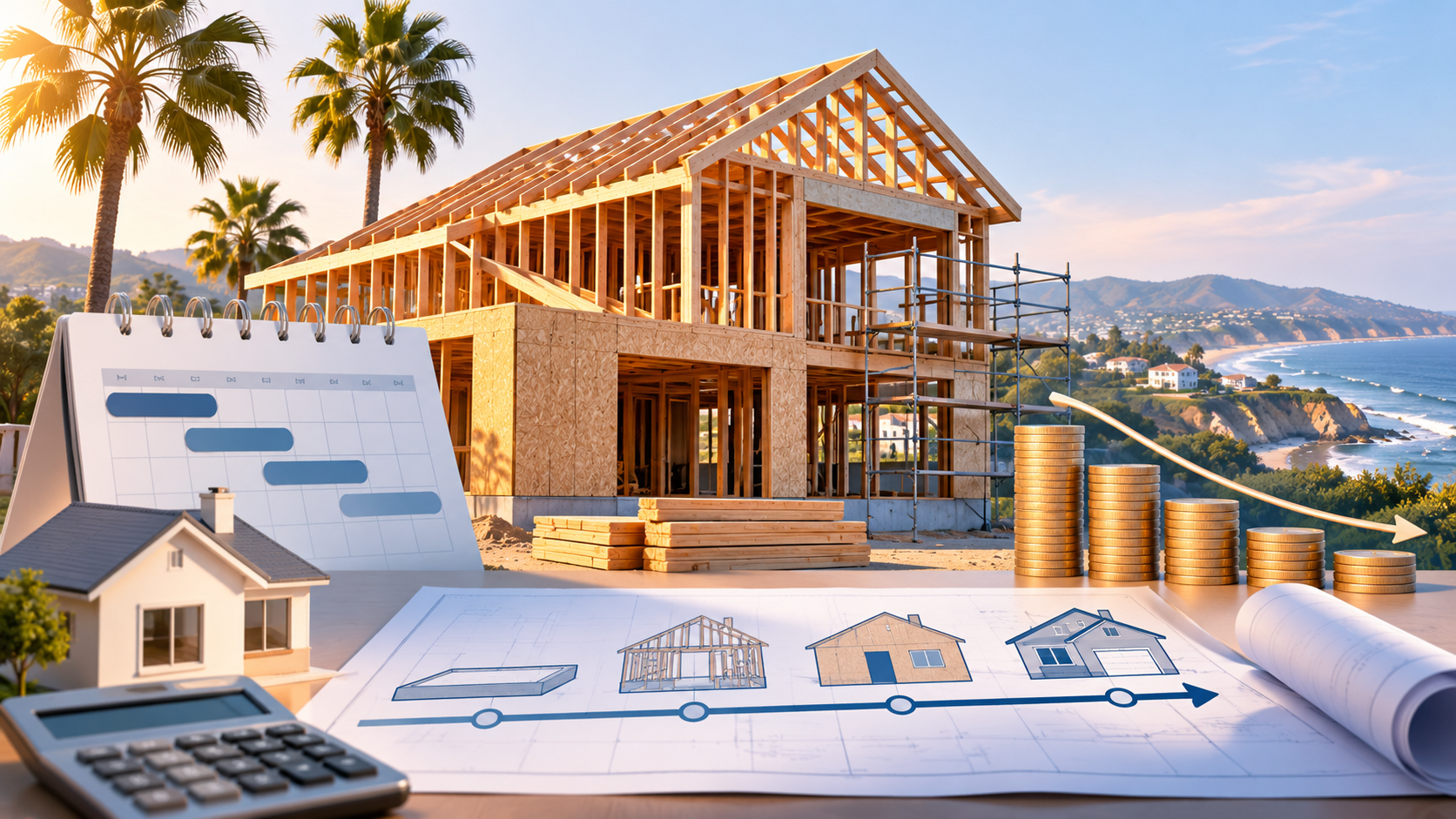
A California home construction loan funds a build through controlled draws, charges construction-period interest under the loan documents, and either converts into or is replaced by permanent financing after completion. The construction period, loan maturity, conversion date, and permanent amortization period are separate terms: a 12-month construction period does not create a 12-year or 30-year construction loan, and a 30-year amortization schedule describes repayment of the completed-home mortgage rather than the time allowed to build the property.
What are the typical terms for a California home construction loan?
A California home construction loan has four core terms: the construction period, draw schedule, loan maturity date, and permanent-financing structure.
- Construction period: The time allowed to complete the approved work and request construction draws.
- Loan maturity: The date when the construction loan must be repaid, converted, or extended.
- Conversion period: The time and conditions required to change construction financing into permanent financing.
- Permanent amortization period: The scheduled period for repaying the completed-home mortgage, such as 15, 20, or 30 years.
A residential construction loan funds the project through approved disbursements rather than a single unrestricted payment. The lender reviews the plans, specifications, construction contract, budget, permits, appraisal, borrower contribution, contractor qualifications, insurance, and draw procedures before funding begins.
A California-wide market average for construction-loan duration does not exist because the term changes with the lender, property type, project complexity, permit schedule, borrower profile, and loan structure. Fannie Mae's single-closing construction-to-permanent framework permits no single construction period longer than 12 months and a total construction period no longer than 18 months, while the permanent loan term cannot exceed 30 years after conversion.
| Financing category | Construction-period structure | Repayment during construction | Repayment after construction |
|---|---|---|---|
| Market-practice residential construction loan | Lender-defined term tied to the approved budget, schedule, and maturity date | Interest-only payments, an interest reserve, or another method stated in the loan documents | Conversion, refinance, sale, or payoff at maturity |
| Fannie Mae single-closing construction-to-permanent loan | No single period longer than 12 months and no total construction period longer than 18 months | Payment method stated in the loan documents; the construction loan automatically converts after completion and satisfaction of conditions | Permanent mortgage term not exceeding 30 years |
| Speculative or investment construction loan | Lender-defined maturity tied to the planned sale, refinance, or other exit | Interest payments, an interest reserve, or capitalized interest under the project documents | Sale proceeds, refinance or takeout financing, investor capital, or another approved payoff source |
How do construction-loan payments work while a home is being built?
For an owner-occupied custom-home construction loan, the standard construction-period payment is interest-only on the outstanding balance advanced through approved draws.
For example, if the lender has advanced $150,000 of a $900,000 commitment, the interest-only payment generally reflects the $150,000 funded balance rather than the undisbursed $750,000. The exact calculation can use a daily balance, monthly balance, minimum payment, full-commitment calculation, interest reserve, or another method stated in the note and construction-loan agreement.
Construction-period interest does not reduce principal unless the borrower makes a principal payment or the loan documents apply funds to principal. After conversion or refinance, the permanent mortgage payment includes principal and interest under the permanent note.
An interest reserve places approved funds into a reserve account to pay construction-period interest. This structure reduces the borrower's current cash payment but increases the amount of project financing used for interest and must be included in the approved budget.
What is a construction draw schedule?
A construction draw schedule is the lender-approved timetable for releasing funds after documented work reaches defined milestones.
A sample California custom-home draw sequence can look like this:
1. Closing and pre-construction: The borrower funds required equity, the lender confirms title and insurance, and approved land, permit, design, and other reimbursable costs are handled under the closing documents.
2. Site work and foundation: The contractor completes grading, utilities, excavation, footings, foundation work, and required inspections; the lender reviews the draw request, invoices, inspection report, and conditional lien waivers.
3. Framing and dry-in: Framing, roof sheathing, roofing, windows, and exterior weather protection are completed; the lender inspects the work before releasing the corresponding draw.
4. Rough mechanical and exterior systems: Plumbing, electrical, heating, ventilation, insulation, fire-safety systems, and exterior work are inspected and documented before funding.
5. Interior finishes: Drywall, cabinets, flooring, fixtures, paint, and finish work are paid through progress draws supported by inspection reports and lien waivers.
6. Final completion: The lender receives final inspection evidence, required local occupancy documentation, final lien waivers, insurance confirmation, and appraisal completion documentation before the final advance or conversion.
The lender can hold back retainage or other undisbursed funds until work is complete, lien exposure is cleared, or a final inspection confirms that the funded scope matches the plans and specifications. If work is incomplete, the lender can delay or reduce the draw, require corrective work, or require additional documentation before releasing funds.
If costs exceed the approved budget, the borrower must fund the gap, obtain an approved increase or secondary financing, reduce the project scope, or use another remedy permitted by the loan documents. A lender does not have to fund an overrun merely because the contractor requests additional money.
How are land purchases, pre-construction costs, and major renovations financed?
Land, construction, and renovation costs are financed through separate budget categories that identify which costs the loan funds, which costs the borrower pays, and which costs the lender reimburses after documentation and approval.
A single-closing construction-to-permanent transaction can finance the lot purchase and construction when the transaction satisfies the program's lot-ownership and underwriting rules. A borrower who already owns the lot can use a construction refinance structure that pays existing liens and finances the build when the program permits it.
Land-acquisition funding can be advanced at closing, while construction funds are generally held for later draws. Borrower equity, deposits, design costs, permit costs, impact fees, utility work, and other pre-construction expenses must be allocated in the budget and supported by the lender's documentation requirements.
A major renovation loan uses an approved scope of work, contractor documentation, inspections, and controlled disbursements. FHA 203(k), Fannie Mae HomeStyle Renovation, construction-only loans, and private renovation facilities apply different property, borrower, appraisal, and completion rules.
What is the difference between a one-time-close and two-close construction loan?
A one-time-close loan closes construction and permanent financing together, while a two-close loan uses a separate construction closing and permanent-financing closing.
One-time-close construction-to-permanent loan
The borrower signs the construction and permanent loan documents at one closing. The lender manages construction draws, and the loan converts into the permanent structure after the project satisfies the completion and conversion conditions.
Key advantages include one coordinated transaction, a defined permanent-loan structure, and reduced exposure to a second closing. The borrower must evaluate the rate-lock method, modification rules, conversion conditions, permanent-loan flexibility, and the risk that updated credit or project information could require requalification.
Two-close construction-to-permanent loan
The borrower closes a construction loan first and obtains permanent financing through a second closing after completion. The second loan can be arranged with the original lender or another lender, subject to that lender's underwriting and property requirements.
Key advantages include greater flexibility to choose permanent-loan terms after construction and the ability to match the exit loan to the completed property. Key risks include a second set of closing costs, a new appraisal or underwriting review, rate changes, requalification risk, modification risk, and the possibility that permanent financing will not be available on the expected terms.
A one-time-close structure fits a borrower who wants permanent financing arranged before construction begins. A two-close structure fits a borrower who wants to select or renegotiate permanent financing after the home is complete or who expects to repay the construction loan through a sale or separate takeout loan.
When do principal-and-interest payments begin?
Principal-and-interest payments begin when the construction loan converts into the permanent mortgage or when a separate permanent loan replaces the construction loan.
Conversion generally requires substantial completion and delivery of the lender's required documents. Those documents can include final inspections, a Certificate of Occupancy or equivalent local authorization, final lien waivers, updated title evidence, insurance, and an appraisal update or completion report confirming that the property matches the approved plans and valuation assumptions.
A fixed-rate permanent loan keeps its note rate fixed while the balance amortizes over the scheduled repayment period. An adjustable-rate permanent loan changes according to the index, margin, adjustment dates, caps, and other terms in the note.
How are spec and investment construction projects repaid?
A spec or investment construction loan is repaid through an approved exit strategy, most commonly the sale of the completed property or a refinance into permanent, rental, portfolio, or commercial financing.
The project documents should identify:
- Sale proceeds: Net proceeds from selling the completed property repay principal, accrued interest, fees, and other required amounts at closing.
- Takeout financing: A permanent mortgage or investment loan replaces the construction loan after completion and appraisal.
- Interest reserve: A funded reserve pays construction-period interest and is included in the project budget and loan balance calculations.
- Balloon maturity: The entire unpaid balance becomes due at the maturity date unless the lender approves a payoff, refinance, sale, or extension.
- Extension fees: An extension beyond the original maturity can create additional interest, inspection charges, legal costs, extension fees, appraisal requirements, and reserve requirements.
- Personal guaranties: The lender can require completion, payment, carry, or repayment guaranties from the borrower, builder, principals, or affiliated entities.
A sale-dependent project carries market, appraisal, construction, insurance, and timing risk because the expected sale price or closing date does not eliminate the loan's maturity obligation.
What California-specific factors affect construction-loan timing and cost?
California construction financing is affected by local permitting, inspection capacity, site conditions, insurance availability, hazard exposure, construction practices, appraisal requirements, and county-level property rules.
Important factors include:
- Permits and inspections: California construction generally requires permits from the relevant building department, and local inspection schedules can control the timing of draw requests and project completion.
- Wildfire and hazard insurance: Properties exposed to wildfire, earthquake, flood, landslide, or other hazards can require specialized coverage, higher premiums, additional underwriting, or lender-approved insurance alternatives.
- County and city requirements: Zoning, grading, septic or sewer approvals, utility connections, access roads, hillside rules, coastal restrictions, historic-preservation rules, and local building amendments can change both budget and schedule.
- Local construction practices: Labor availability, subcontractor sequencing, material delivery, prevailing local methods, and regional permitting practices affect how quickly a contractor can reach each draw milestone.
- Appraisal completion requirements: The lender can require an as-completed appraisal, final inspection, completion report, Certificate of Occupancy, and confirmation that the completed property conforms to the approved plans.
- Property characteristics: Rural parcels, hillside lots, high-fire-hazard areas, coastal properties, unincorporated land, and parcels requiring unusual infrastructure create additional feasibility, insurance, and valuation issues.
FAQ
How long is a California construction loan?
A California construction loan lasts for the construction period stated in the loan documents and must be repaid, converted, or extended by its maturity date. Fannie Mae single-closing transactions use no single construction period longer than 12 months and no total construction period longer than 18 months.
Are construction-loan payments interest-only?
An owner-occupied construction loan commonly uses interest-only payments on the outstanding drawn balance during construction. The loan documents can instead provide for an interest reserve, a minimum payment, a full-commitment calculation, or another payment method.
How frequently are construction-loan draws funded?
Draw frequency follows the lender-approved schedule and the contractor's progress. A project can use milestone draws, monthly progress draws, or another documented schedule tied to inspections, invoices, lien waivers, and completed work.
When does construction financing convert to a mortgage?
Construction financing converts after the home satisfies the lender's completion conditions, which can include final inspections, occupancy documentation, lien waivers, insurance, and appraisal completion evidence.
What are construction-loan extension fees?
Construction-loan extension fees are charges assessed when the lender extends the maturity date or construction period. The extension can also require updated inspections, reserves, insurance, appraisal evidence, financial documents, and a revised completion schedule.
What is a balloon payment on a construction loan?
A balloon payment is the full unpaid loan balance due at maturity instead of a balance fully amortized through the scheduled monthly payments. Sale proceeds, refinance financing, or other approved funds must satisfy the balloon obligation.
What happens if the project runs over budget?
The borrower must cover the overrun, obtain an approved loan increase or secondary financing, reduce the scope, or use another remedy allowed by the loan documents. The lender can suspend draws for incomplete work or insufficient collateral support.
Should I choose a one-time-close or two-close loan?
Choose a one-time-close structure when you value a coordinated path to permanent financing, and choose a two-close structure when you need flexibility to arrange or change the permanent loan after construction. Compare rate-lock treatment, closing costs, requalification risk, conversion conditions, modification rights, permanent-loan terms, and the project exit strategy.
Closing summary
Before choosing a California home construction loan, compare the construction period, maturity date, draw rules, inspection process, retainage, lien-waiver requirements, interest calculation, interest-reserve treatment, conversion mechanics, permanent-loan term, appraisal completion requirements, extension costs, guaranties, and exit strategy. The right structure is the one whose funding schedule and repayment plan match the project's permits, budget, construction milestones, insurance requirements, completion evidence, and expected source of repayment.
Sources
- Fannie Mae, “Conversion of Construction-to-Permanent Financing: Single-Closing Transactions.” (guide-selling.fanniemae.com)
- Fannie Mae, “Construction-to-Permanent Financing.” (singlefamily.fanniemae.com)
- Fannie Mae, “Single-Closing Construction-to-Permanent Financing Transaction Process.” (singlefamily.fanniemae.com)
- Fannie Mae, “FAQs: Construction-to-Permanent Financing.” (singlefamily.fanniemae.com)
- Fannie Mae, “Requirements for Verifying Completion and Postponed Improvements.” (singlefamily.fanniemae.com)
- Office of the Comptroller of the Currency, “Commercial Real Estate Lending.” (occ.gov)
- California Contractors State License Board, “Building Permit Requirements.” (web.cslb.ca.gov)
- California Department of Insurance, “Residential Insurance: Homeowners and Renters.” (insurance.ca.gov)
> Important limitations: Loan availability, pricing, underwriting, construction periods, draw procedures, interest calculations, reserves, conversion conditions, insurance requirements, extension fees, guaranties, appraisal standards, and repayment obligations are controlled by the lender's current program guidelines and executed loan documents. Local building departments, insurers, appraisers, contractors, and lenders can impose additional requirements.
References
- https://www.usbank.com/home-loans/mortgage/construction-loans.html
- https://singlefamily.fanniemae.com/media/document/pdf/single-closing-financing-transaction-process-guide
- https://www.occ.ustreas.gov/publications-and-resources/publications/comptrollers-handbook/files/commercial-real-estate-lending/pub-ch-commercial-real-estate.pdf
FAQ
How long is a California construction loan?
A California construction loan lasts for the construction period stated in the loan documents and must be repaid, converted, or extended by its maturity date. Fannie Mae single-closing transactions use no single construction period longer than 12 months and no total construction period longer than 18 months.
Are construction-loan payments interest-only?
An owner-occupied construction loan commonly uses interest-only payments on the outstanding drawn balance during construction. The loan documents can instead provide for an interest reserve, a minimum payment, a full-commitment calculation, or another payment method.
How frequently are construction-loan draws funded?
Draw frequency follows the lender-approved schedule and the contractor's progress. A project can use milestone draws, monthly progress draws, or another documented schedule tied to inspections, invoices, lien waivers, and completed work.
When does construction financing convert to a mortgage?
Construction financing converts after the home satisfies the lender's completion conditions, which can include final inspections, occupancy documentation, lien waivers, insurance, and appraisal completion evidence.
What are construction-loan extension fees?
Construction-loan extension fees are charges assessed when the lender extends the maturity date or construction period. The extension can also require updated inspections, reserves, insurance, appraisal evidence, financial documents, and a revised completion schedule.
What is a balloon payment on a construction loan?
A balloon payment is the full unpaid loan balance due at maturity instead of a balance fully amortized through the scheduled monthly payments. Sale proceeds, refinance financing, or other approved funds must satisfy the balloon obligation.
What happens if the project runs over budget?
The borrower must cover the overrun, obtain an approved loan increase or secondary financing, reduce the scope, or use another remedy allowed by the loan documents. The lender can suspend draws for incomplete work or insufficient collateral support.